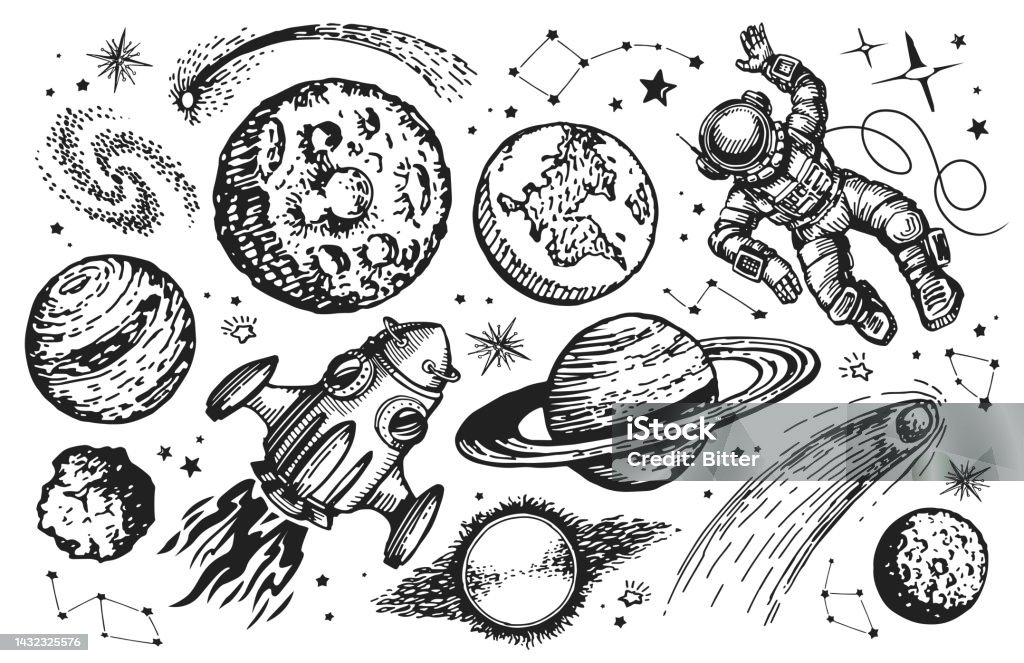

Space drawings are more than simple pictures of planets and stars. They are visual journeys into the unknown, shaped by human curiosity, scientific understanding, and limitless imagination. From a child sketching a rocket ship on a notebook to a professional artist illustrating distant galaxies, space drawings allow people to explore what lies beyond Earth without ever leaving the ground. This article explores space drawings in depth—what they are, why they matter, how they are created, and how they continue to evolve with time and technology.
What Are Space Drawings?
Space drawings are artistic representations inspired by outer space. They can include planets, moons, stars, galaxies, nebulae, astronauts, spacecraft, alien worlds, and imagined cosmic events. These drawings may be realistic, closely following scientific data, or highly imaginative, showing worlds that exist only in the artist’s mind.
Unlike scientific diagrams, space drawings are not limited to strict accuracy. They blend facts with feelings. An artist might draw Saturn with correct rings but color the sky in impossible shades of purple and gold to express wonder or mystery. This freedom is what makes space drawings so powerful—they sit at the intersection of science and art.
A Brief History of Space Drawings
Long before telescopes existed, humans looked at the night sky and drew what they saw. Ancient civilizations created star maps, carvings, and symbolic drawings of the Sun, Moon, and stars. These early space drawings were not just decorative; they were tools for navigation, agriculture, and religious belief.
During the Renaissance, artists and scientists began working more closely. Astronomers sketched the Moon’s surface after observing it through early telescopes. These drawings were detailed and careful, serving as records of discovery. As science advanced, so did space art.
In the 20th century, space drawings entered a new era. With the rise of science fiction, artists imagined space travel, alien planets, and futuristic technology. Magazine covers, book illustrations, and movie concept art shaped how the public imagined space. Many of these drawings inspired real scientists and engineers, proving that art can influence reality.
Why Space Drawings Matter
Space drawings matter because they help people connect emotionally with the universe. Space is vast and often difficult to understand through numbers and equations alone. Drawings translate complex ideas into visual stories that anyone can appreciate.
For students, space drawings can spark interest in science. A beautifully drawn galaxy may encourage a young viewer to learn about astronomy. For scientists, artistic interpretations can help communicate ideas to the public. For artists, space offers endless inspiration, free from the limits of everyday life.
Space drawings also reflect human hopes and fears. Some show peaceful exploration and unity, while others depict isolation or danger. In this way, space art becomes a mirror of human thought, projected onto the stars.
Realistic vs. Imaginative Space Drawings
Space drawings generally fall into two broad categories: realistic and imaginative.
Realistic Space Drawings
Realistic space drawings aim to show the universe as accurately as possible. Artists study photographs from telescopes, space missions, and scientific models. They pay attention to details such as lighting, scale, and surface texture. These drawings are often used in textbooks, documentaries, and educational materials.
Creating realistic space art requires patience and research. Artists must understand how light behaves in space, how planets differ from one another, and how distance affects appearance. The goal is not fantasy, but clarity and truth.
Imaginative Space Drawings
Imaginative space drawings are guided by creativity rather than data. Artists invent new planets, strange life forms, and dramatic cosmic events. Gravity may behave differently, colors may be exaggerated, and physics may bend to serve the story.
These drawings are common in science fiction, games, and personal art projects. They allow artists to explore ideas such as life beyond Earth, future civilizations, and alternate universes. While not scientifically accurate, imaginative space drawings often express deeper questions about existence and possibility.
Common Themes in Space Drawings
Space drawings often explore certain recurring themes:
- Exploration and Discovery: Astronauts stepping onto unknown worlds or ships traveling through deep space.
- Isolation and Scale: Small human figures against vast galaxies, emphasizing how tiny we are in the universe.
- Hope and Future: Space cities, advanced technology, and peaceful cosmic societies.
- Mystery and the Unknown: Dark nebulae, distant stars, and hidden cosmic forces.
- Life Beyond Earth: Aliens, alien landscapes, and unfamiliar ecosystems.
These themes give space drawings emotional depth and make them relatable despite their cosmic setting.
Tools and Materials for Space Drawings
Space drawings can be created using many different tools, depending on the artist’s style and resources.
Traditional Tools
- Pencils: Ideal for sketching planets, craters, and shading space backgrounds.
- Colored Pencils: Useful for adding subtle color gradients to stars and nebulae.
- Ink Pens: Great for sharp details, spacecraft outlines, and star fields.
- Paints (Watercolor or Acrylic): Perfect for creating glowing effects and dramatic cosmic scenes.
Traditional tools encourage a hands-on connection with the artwork and are often favored by beginners and professionals alike.
Digital Tools
Digital drawing tablets and software have become very popular for space art. They allow artists to experiment freely with colors, layers, and effects.
Advantages of digital tools include:
- Easy corrections
- Unlimited color options
- Realistic lighting effects
- Faster experimentation
Digital space drawings are widely used in movies, games, and online art communities.
The Creative Process Behind Space Drawings
Creating a space drawing usually follows several steps, though each artist develops their own approach.
- Inspiration: This may come from science, dreams, movies, or simple curiosity about the universe.
- Concept: The artist decides what the drawing will show—a planet, a mission, a cosmic event.
- Sketching: A rough outline helps plan composition and balance.
- Detailing: Shapes are refined, textures added, and elements defined.
- Color and Light: Colors bring the scene to life, while light creates depth and realism.
- Final Touches: Small details such as stars, reflections, or shadows complete the piece.
This process can take hours or even weeks, depending on complexity.
Space Drawings and Education
Space drawings play an important role in education. Visual learning helps many people understand complex topics more easily than text alone. Drawings of the solar system, black holes, or galaxies can make abstract ideas more concrete.
Teachers often encourage students to draw space-related subjects to reinforce learning. This not only improves understanding but also builds creativity and confidence. When students create their own space drawings, they become active participants in learning rather than passive observers.
Space Drawings in Popular Culture
Space drawings are everywhere in popular culture. Movie posters, album covers, book illustrations, and video games all rely on space art to set mood and tell stories. Iconic images of spaceships, distant planets, and star-filled skies have become part of global visual language.
These drawings shape how people imagine space. Even those who have never studied astronomy often have a clear mental image of what space “looks like,” largely because of art.
Emotional Impact of Space Drawings
One of the most powerful aspects of space drawings is their emotional effect. Looking at a drawing of Earth floating alone in space can inspire feelings of unity and responsibility. A dark, endless galaxy may evoke awe or fear. A bright nebula might suggest beauty and hope.
Space drawings remind viewers that the universe is vast, mysterious, and still largely unknown. This perspective can be both humbling and inspiring.
The Future of Space Drawings
As technology advances, space drawings will continue to evolve. New discoveries provide fresh inspiration, while improved tools allow for greater realism and experimentation. Virtual reality and augmented reality may soon allow people to step inside space drawings, turning art into immersive experiences.
Despite these changes, the core purpose of space drawings will remain the same: to help humans imagine what lies beyond and reflect on their place in the universe.
Conclusion
Space drawings are a unique form of art that blend imagination, science, and emotion. They have existed throughout human history and continue to evolve with culture and technology. Whether realistic or fantastical, created with pencil or pixels, space drawings allow us to explore the universe in a deeply personal way.
They r