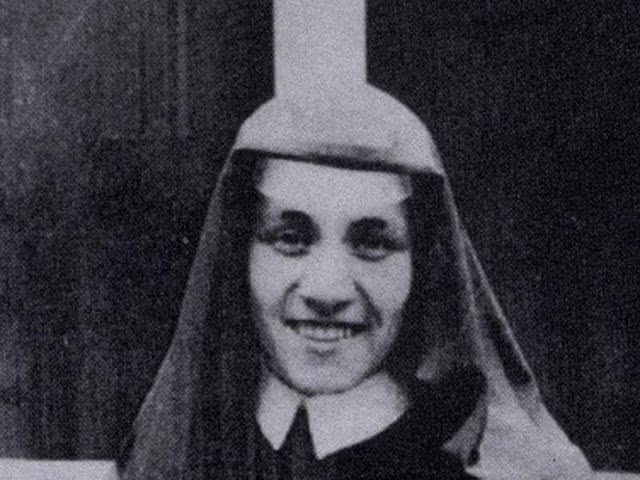

Mother Teresa is a name known across the globe as a symbol of selfless humanitarian service. While most people recognize her for her work in India or for her Nobel Peace Prize, fewer know the story of her early years—the youthful experiences, family life, and formative moments that shaped her path to becoming one of the most influential figures of the 20th century. Artofit
1. Early Life and Family Background
Mother Teresa was born Anjezë Gonxhe Bojaxhiu on 26 August 1910, in Skopje, which at the time was part of the Ottoman Empire (today North Macedonia). She was born into a devout Catholic Albanian family that instilled deep values of faith, compassion, and generosity in her from a very young age. IBTimes India
Her mother, Drana Bojaxhiu, played a significant role in nurturing her sense of empathy—often inviting the poor into their home for meals alongside the family. This early exposure to kindness and charity planted the seeds for her future life’s work. Artofit
From her earliest memories, Anjezë was surrounded by community and faith, and life in Skopje exposed her to everyday struggles and joys that would deeply inform her worldview. Artofit
2. Childhood and Personality Traits
Photos from her childhood reveal a young girl with a soft but determined gaze—someone who seemed thoughtful even in her youth. Hindustan Times
Even as a child, Anjezë was described as compassionate, observant, and reflective. Friends and classmates reportedly noted her eagerness to help in every little way, whether assisting in household chores or comforting a classmate in distress. This early evidence of empathy hinted at the future nun’s calling. Artofit
3. A Calling to Serve at a Young Age
At around 12 years old, she experienced what would later be described as her first true spiritual calling—a moment that would influence the trajectory of her life. She felt an overwhelming desire to live a life dedicated to God and to service. Artofit
As she grew older, her dreams expanded. She wanted to be a teacher, and she enjoyed creative pursuits such as writing poetry and music, which showcased a sensitive and expressive young spirit alongside her emerging devotion to serving others. Telegrafi
4. Leaving Home — The Beginning of a Journey
When she turned 18, Anjezë made a life‑changing decision: she left her hometown and traveled to Ireland to join the Sisters of Loreto. Telegrafi
This was not only a geographical shift but a spiritual and vocational transformation. In Ireland, she received formal training and preparation for missionary work. Her time with the Loreto sisters allowed her to learn English and deepen her theological understanding—skills that would later support her work in India. Telegrafi
5. New Name, New Mission
Upon entering the Loreto order, she took the name Sister Mary Teresa, choosing this new name after St. Thérèse of Lisieux, a French nun beloved for her “little way”—the idea that small acts of love can become powerful contributions to humanity. Artofit
This name change symbolized her step into a lifelong mission of love and service. In 1928, she set off for India, where her commitment would blossom into a historic legacy. Artofit
6. Life in India — Where It All Took Shape
After arriving in Calcutta (Kolkata), she spent several years teaching at a girls’ school, eventually becoming its principal. It was here that her heart became deeply moved by the plight of the city’s poorest residents. Artofit
While her early life was guided by family and community, her experiences in the crowded streets of Calcutta ignited a deeper desire to serve the poorest of the poor—people who had been ignored by society. This comparison between her youth, which was relatively stable and nurturing, and her later encounters in Calcutta highlighted how radically her path would evolve. Artofit
7. Founding the Missionaries of Charity
In 1950, she founded the Missionaries of Charity, a congregation dedicated exclusively to serving the destitute. Through her leadership, the order expanded rapidly and became known around the world for its commitment to the marginalized. Artofit
This work was rooted in all that she had been taught as a child—compassion, service, and deep spiritual faith. Looking back at her early life helps us understand how deeply these values were embedded in her character long before she became an international figure. Artofit
8. Youth Reflected in Her Later Humanitarian Philosophy
Mother Teresa’s early life reveals a consistent thread: a deep love for humanity that guided her decisions even at a young age. Her upbringing in a culturally rich and empathetic family environment gave her the confidence to embrace suffering not with despair, but with compassion. Artofit
Her later missionary work—caring for the sick, the destitute, the dying—was an extension of the nurturing mindset cultivated in her early childhood and adolescence. Artofit
9. Legacy: Beyond Childhood and Youth
Today, Mother Teresa is remembered not just for her work, but for the transformation she inspired in others. From a young girl in Skopje with a deep sense of purpose to a globally revered humanitarian and saint, her journey remains remarkable. Artofit
Her youthful experiences remind us that character shapes destiny, and that the values we cultivate early in life can ripple outward to impact millions around the world. Artofit